The Holy Ground of Grief (part II) How we Honored Our Last Two Days Together
(If you missed Part I, start there—it’s about the anticipation of goodbye to my foster baby of 2 years.)
It’s been a week since I spent my last 48 hours with my baby.
Their baby.
Our baby.
His name means “little fire.” And he lit a flame in my heart- one that brought a warmth to my soul, a light into our home. How could I best honor the last two days I had with this boy, this blessing?
How do you spend your time intentionally with a loved one when it could be your last?
I knew presence would matter most. So I canceled my plans and cleared my schedule for those two days. But the questions came anyway, layering over the anticipation of our final days: Should we do something special? Should we lean into our ordinary rhythms, letting them settle deeper into his heart and soul? How could I find tangible ways to mark what was happening- his transition, my children’s loss and change, my own ache of saying goodbye?
And the goodness, too, of what he was moving toward: reunification with his family.
(If you’ve loved a foster child long enough to say goodbye, you know this tension.
You celebrate the very thing that breaks your heart.
You pray for reunification—and then grieve when it comes.
This is the quiet paradox of foster care: loving a child with your whole heart while knowing you were never meant to keep them).
I decided on rhythm. Routine. The small rituals that make a life together.
We woke in the morning as we always did, usually with at least two kids in my bed. I made breakfast for five children. Got them ready for school and did my best to keep the chaos at bay. We spent time together as a family before the first school bus came at 7:30. I bundled him up to walk with Patrick and me to the corner, where he loved to wave as the bus pulled away. We lingered outside in the cold—he never minded the cold, and no matter the weather, he’d protest when it was time to go inside.
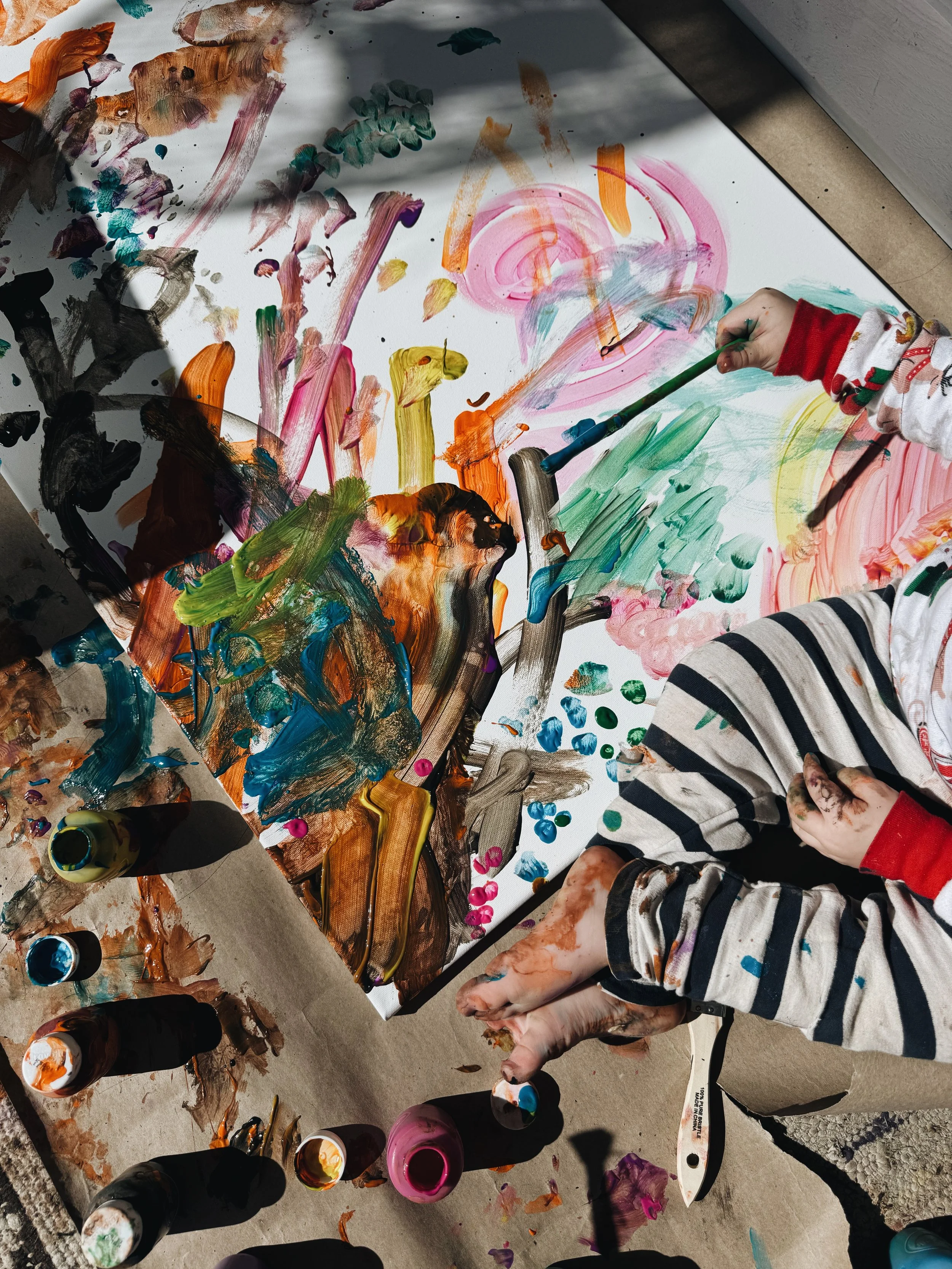
In the afternoon, before the other children came home from school, I got out the paint. Pink, green, turquoise, yellow, orange, brown, black. I started with the sunrise colors—sunny yellow, apricot, terra-cotta, blush pink—because this boy was sunshine to me.
One of my favorite writers, the poet and philosopher John O’Donohue, writes about how color is always a dance between an object and light.
He says:
“When a ray of light hits the natural vibration of an object, it alters the vibration. It becomes absorbed itself, and this alteration, and what is reflected toward us, is the object’s color… So the color we perceive is the remains of the other colors which have been absorbed. The color that gleams toward us lives from its invisible ghosts—the colors buried deep in the seen object.”
I had to listen to that chapter four times.
I couldn’t help but think about how this shows up in the human experience. How one person’s light and color imprint on our own, shaping us into something beautifully unique.
He goes on to say that color reveals the vulnerability of an object—its being-seen-ness.
The vulnerability of loving and seeing and being seen changes us at the core.
He picked up a paintbrush and carefully chose his colors. We spent what felt like an expansive time on the porch with the canvas between us, the sunny afternoon light casting shadows of his toddler frame. This symbol of our lives, intimately intertwined. for these last two years.
I’m always learning to find the balance of shadow and light. Always growing in understanding about how every person that comes into our lives leaves us different than before.
And just like he often did, he surprised me with unexpected joy: he painted his feet and wanted to take a walk across the canvas. Slippery sunset footprints. His mark on our shared work of art. His forever mark on my heart.
I had typed out a prayer and blessing to read over him with our whole family by candlelight after dinner. With five squirrly kids ages 2-7, the ritual was messier than I’d envisioned. But that’s the reality of life.
“We light this candle to remind us that love is like a light. Even when someone goes to live in a different home, the love doesn’t go out.
You came into our family, and we became your family. And you became part of us. Nothing will ever change that…wherever you go, our love goes with you.”
We spoke the things we loved about him. We spoke what he’d given us. We prayed God would carry him. We blew out the candle together.
It wasn’t the romantic, orchestrated moment I’d imagined. But it was something sacred anyway. We marked this goodbye. We acknowledged what we’d poured into him, what he’d given us, and how his love and light had shaped our family forever. Maybe my children will remember it. Maybe they won’t.
But the act of marking and honoring the significance of this moment gave our grief a shape.
It gave us a way toward living through the loss and finding beauty in the breaking.
That night, putting him to bed for the last time as his mother, I whispered prayers through tears. “I love you. I’m going to miss you so much.”
I tried to pour into those words everything my heart held: You are delighted in. We will always be connected. My love for you doesn’t end. I’m sorry and I wish you could stay, but this was always the plan.
I know now that this little fire lit something in me that still burns.
Yes, for him.
But it’s also spreading—into a deeper desire, maybe even a calling, to write about grief. To share how reunification in foster care is a beautiful thing! And it can still be painful for the ones saying goodbye.
To explore how brokenness and beauty can coexist. How suffering and joy are not opposites, but companions—reminding us that we are alive, present, and still connected to Love.
As Parker Palmer writes:
“To move close to God is to move close to everything that human beings have experienced. That includes a lot of suffering, and a lot of joy.”
So how do we do this? How do we hold suffering and joy together?
I’d genuinely love to hear your thoughts in the comments below.
Share a moment when you’ve held grief and beauty in the same breath—a ritual, a quiet act, a way you’ve marked significance. What anchored you? What helped you carry both?
Next week, I’ll be sharing a bit more of our story: The Day We Said Goodbye
Thanks so much for reading.
-Abby
P.S. If this story resonated with you, feel free to share it with someone who has loved a child they had to let go of. Foster care can be beautiful and heartbreaking all at once—and none of us are meant to carry that alone.
More on Stubstack: With Open Hands! Subscribe for free to receive new posts and support my work.